Tuesday, April 5, 2011

Lucky to Be Local

Putting your words out into your community is a way to "keep it local."
I recently received the second issue of The Más Tequila Review. It's a substantial endeavor, undertaken by an Albuquerque poet with an MFA in creative writing and no job to support this journal. It's a hefty, but not slick, publication. A labor, a love, a publication with guts. 


Richard Vargas, the man behind this, is just one of many New Mexicans creating new journals. Here are a few other journals, with links, and their tireless editors, determined to get our words out.


New Mexico Poetry Review - Kathleen Johnson
Malpaís Review - Gary Brower
Adobe Walls - Kenneth Gurney
Santa Fe Literary Review - Miriam Sagan


I don't know where you live, or what journals are available in your area, but I want to encourage you to send your poems to local journals above all others. There is something intensely satisfying about being with your peers, your friends, poets in your area that you admire. 


It feels necessary and honorable to be allowed to put your voice in places near your house, to let it reach into backyards and parks and coffeeshops that you love, into the sky and the trees, into the ethereal center of your world. 


These journals, these editors and their teams, are the ones that can help you make that happen. 

Monday, April 4, 2011

What Tiger Mending Has to Do with Poetry Analysis

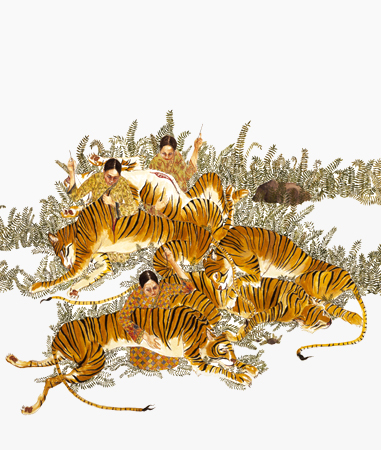
A painting by Amy Cutler entitled "Tiger Mending"
on view at SITE Santa Fe
In a recent post, I shared a poem by Adrienne Rich called "Aunt Jennifer's Tigers." Someone wrote in asking for insight.... "Why tigers?" 

I believe we interpret poems, and artwork for that matter, from our own history, what we know, and also from what's around us now, our moods, the spaces we find ourselves in.

Lately, I've been hanging around the galleries at SITE Santa Fe, Santa Fe's cutting-edge international art space. I'll be teaching a fairy tale writing workshop there at the end of the month, in conjunction with a surreal exhibit, and I've wanted to fully experience the art.

When I read Adrienne Rich's poem, I can't help but think about Amy Cutler's strange little painting in the first gallery, "Tiger Mending" (pictured above). In the Cutler painting, expressionless women painstakingly stitch stripes back on depleted tigers, as though their concentrated effort will enliven the animals.

As an artist who has worked primarily with fabric and thread, I know all too well that sewing is a gender-specific role, one that is typically considered quiet and demure. The women in Cutler's painting and Aunt Jennifer all seem without voice, stuck in their roles. But that doesn't have to be what sewing is; it has always felt to me quite powerful -- the ability to create something out of stitches. 

From the poem, we know that Aunt Jennifer needs a way out of a rotten situation with her husband, and we know too - from the line "When Aunt is dead, her terrified hands will lie / Still ringed with ordeals she was mastered by," that she'll never get it. 

For Aunt Jennifer, embroidering those tigers, and making them "prancing, proud and unafraid," is her only way into a better life. In that fantasy place, she is golden and formidable, surrounded by a wide vista where she can roam freely. The two-dimensional tigers she's drawing on her canvas give Aunt Jennifer what little resilience and power she has. 

No wonder she is sewing on their stripes.

Sunday, April 3, 2011

How I Found James Magee's Poems

Photo of The Hill by Tom Jenkins.

One evening this week, I spent some time studying the photos in a book called The Hill. The book showcases an isolated, secret artwork in the rocky, barren desert of West Texas. The artist, James Magee, has spent 25 years creating four buildings, connected by causeways. He works, it seems, with a religious fervor and unending perserverence.

The stone work grew as a poem does, rock by rock, word by word, moment by moment. The interior installations, so striking in photos, are dense with symbolism.

Toward the end of the book, I found pages of what looked like poems. The Hill website explains these "poems": On occasion, while visitors take the considerable time required to study the works, Magee will recite their “titles”— in effect, lengthy poetic texts, at once allusive and immediate.

This intrigues me. For years, I wrote poems to accompany my artwork - until finally I separated the two mediums. I always wrote when the work was finished as a way to enlarge what I had created with my hands. I wanted viewers to "see" the work in yet another way. Sometimes the poems elucidated; other times confounded.

If you want to know more about The Hill, a fascinating, little-seen site, or its artist, check out the article in Granta magazine.

Saturday, April 2, 2011

Audio Saucepan, Edgar Allen Poe and James Magee


I've been compiling music and poems for tomorrow night's radio show. All week I've been listening to new jazz and old Appalachian sounds. There's a slight element of creepiness to the show, but Poe's words will always do this, and there's the ever-present unexpected...

Along with broadcasting "Annabel Lee," I will be reading one of James Magee's extended "poem-titles" on tomorrow's show. It is, in fact, the source for the title of the episode.

In the next post, I'll give you an earful on Magee, who is an artist and former attorney, esconced in a large-scale, lifetime project. Though not a poet, words have a remarkable place in his visionary artwork.

"Audio Saucepan" airs Sundays, 5-6PM (Mountain Time) on Santa Fe Public Radio KSFR 101.1FM, with simultaneous access via the internet at www.ksfr.org.

Tomorrow's show (April 3) is "The Shameless Promise Episode” and includes the poems “Annabel Lee” by Edgar Allan Poe (from The Essential Edgar Allan Poe, Naxos AudioBooks); “Untitled (Sometimes yes.)” by James Magee (from The Hill, Prestel); and an excerpt from Adam Foulds' epic verse narrative The Broken Word (Penguin Books); along with a wide variety of intriguing and unexpected music.

Please tune in!

Friday, April 1, 2011

Interpreting a Poem - Part 2

Another glorious photo by Michael Nichols.
There is such a dichotomy between the tigers - proud and calm -
and Aunt Jennifer.

In the last post, I showed you a poem by Adrienne Rich - "Aunt Jennifer's Tigers."

Yesterday at the Tutoring Center, where I work part-time to assist beginning level students in everything from grammar and punctuation to literature and essay organization, I had the chance to help an older man, retired military after 30 years, find his way into this poem.

This poor student was completely lost in the words and symbolism. He had no idea where to start. And he was so worried about finding 600 words to say about a 12-line poem that he had gotten a little bit frantic. He told me it was impossible.

He was in a hurry to understand it. And I don't think poems work that way.

I asked him questions, wanted to break it down simply for him…what is Aunt Jennifer doing? He said she was painting. I asked him how he knew that. Well, he didn't. 

I pointed to the word "needle" and asked him to imagine that beautiful ivory needle. Then, he noticed the word "wool." He decided she was making a quilt.

Little by little, we broke the poem apart into bits he could chew on. We talked and talked about the meanings, or possible meanings, of the words. I told him poems take time; they take multiple readings. They take a willingness to suspend your fully conscious, normal mind sometimes.

And, after an hour's conversation about this very poem, the symbolism and word choice, he blithely asked: "But what should I write about?"